ECR 2026 and RSNA 2025 Highlights: What Radiologists Need to Know
🔑 Key Takeaways
- 🔑 ECR 2026 set an all-time attendance record of 22,418 participants from 121 countries, with 11,376 submitted abstracts (15% increase over 2025), under the theme “Rays of Knowledge.”
- 🔑 RSNA 2025’s “Imaging the Individual” theme shifted focus from AI novelty to operational impact — emphasizing real-world deployment, measurable outcomes, and radiologist well-being.
- 🔑 Key scientific highlights included the first FDA-cleared foundation model for radiology (Aidoc CARE1), five new RapidAI FDA clearances, and the ESTI/ESR endorsement of AI for lung screening.
- 🔑 ECR 2026’s In Focus program “The Art of AI in Clinical Practice” addressed AI ethics, regulatory frameworks, and the radiologist as “clinical orchestrator” — emphasizing human-AI partnership over replacement.
- 🔑 Industry trends included theranostics maturation, sustainability in imaging, AI-powered MRI acceleration, and the emergence of agentic AI workflows for radiology.
RSNA 2025: “Imaging the Individual” — From Novelty to Necessity
The 111th Scientific Assembly of the Radiological Society of North America, held November 30 – December 4, 2025, in Chicago under the theme “Imaging the Individual,” marked a notable tonal shift in the radiology AI conversation. After years of asking “Is AI ready?”, the field moved decisively to “How do we operationalize AI workflow innovations in radiology at scale?” The conversations at RSNA 2025 centered on practical deployment, measurable outcomes, and the human factors that determine whether AI tools are actually adopted or abandoned in daily workflows.
AI: From Hype to Impact
Artificial intelligence dominated the scientific program, but with a distinctly practical orientation. Several landmark developments were announced or presented. Aidoc’s CARE1 foundation model received FDA clearance in February 2025 — the first foundation-model-powered clinical AI to achieve regulatory authorization, signaling a new era of general-purpose foundation model breakthroughs in imaging. RapidAI announced five new FDA 510(k) clearances in November 2025, expanding its stroke and neuroimaging portfolio with Rapid LMVO, Rapid DeltaFuse, Rapid MLS, Rapid OH, and Rapid Aortic modules. Multiple sessions showcased AI’s impact on reporting efficiency, with one health system reporting a 20% reduction in reporting time after AI implementation.
The concept of agentic AI emerged as a major talking point — autonomous systems capable of executing multi-step workflows without continuous human direction. Presenters described potential applications including automated pre-reading of screening mammograms, AI-generated draft reports for routine examinations, and intelligent case routing based on AI-determined acuity. However, speakers consistently emphasized that agentic AI amplifies rather than replaces the radiologist’s role, freeing capacity for complex decision-making and clinical consultation.
Precision Imaging and Beyond-Diagnosis Value
The “Imaging the Individual” theme manifested in growing emphasis on personalized imaging strategies. Presentations highlighted AI-derived body composition analysis from routine CT, opportunistic cardiovascular risk assessment from lung cancer screening LDCT, and multimodal fusion of imaging with genomic data for treatment planning. The LUNA25 Challenge results, benchmarking AI against radiologists for lung nodule malignancy risk estimation on screening CT, were presented, contributing to the growing evidence base for standardized AI evaluation. Theranostics — the integration of diagnostic imaging with targeted radionuclide therapy — saw perhaps its strongest representation ever at RSNA, transitioning from a niche subspecialty to a mainstream clinical application.
Sustainability and Well-Being
Environmental sustainability emerged as an unexpected but significant theme. Data presented showed that radiology departments can account for up to 24% of a hospital’s total carbon emissions, and the healthcare sector overall represents 8.5% of US greenhouse gas emissions. AI-driven workflow optimization, energy-efficient scanner designs, helium-saving MRI technologies, and reduced unnecessary imaging were proposed as actionable sustainability measures. Radiologist well-being received equal attention, with sessions addressing burnout reduction through AI automation, workforce shortages, and the importance of maintaining human connections in an increasingly digital practice environment.
| Parameter | RSNA 2025 (Chicago) | ECR 2026 (Vienna) |
|---|---|---|
| Theme | “Imaging the Individual” | “Rays of Knowledge” |
| Dates | Nov 30 – Dec 4, 2025 | March 4–8, 2026 |
| Attendance | Not officially published at time of writing | 22,418 (record; +9% vs. ECR 2025) |
| Abstracts | Thousands submitted | 11,376 (record; +15% vs. ECR 2025) |
| AI Focus | Operationalization, agentic AI, measurable impact | “The Art of AI in Clinical Practice” — ethics, democratization, screening |
| Plenary Speakers | Multiple sessions on AI, precision medicine | Kottler & Kahn (AI), Bolte Taylor (neuroplasticity), Vilgrain (liver imaging) |
| Key Industry Theme | AI platforms, theranostics, sustainability | Interventional radiology innovation, MRI acceleration, AI workflow integration |
| New Formats | Continued emphasis on workshops, hands-on AI labs | “Out of the Box,” “How We Do It,” “Decoding the Diagnosis: Radiology Meets Pathology” |
ECR 2026: “Rays of Knowledge” — Education at the Heart of Radiology
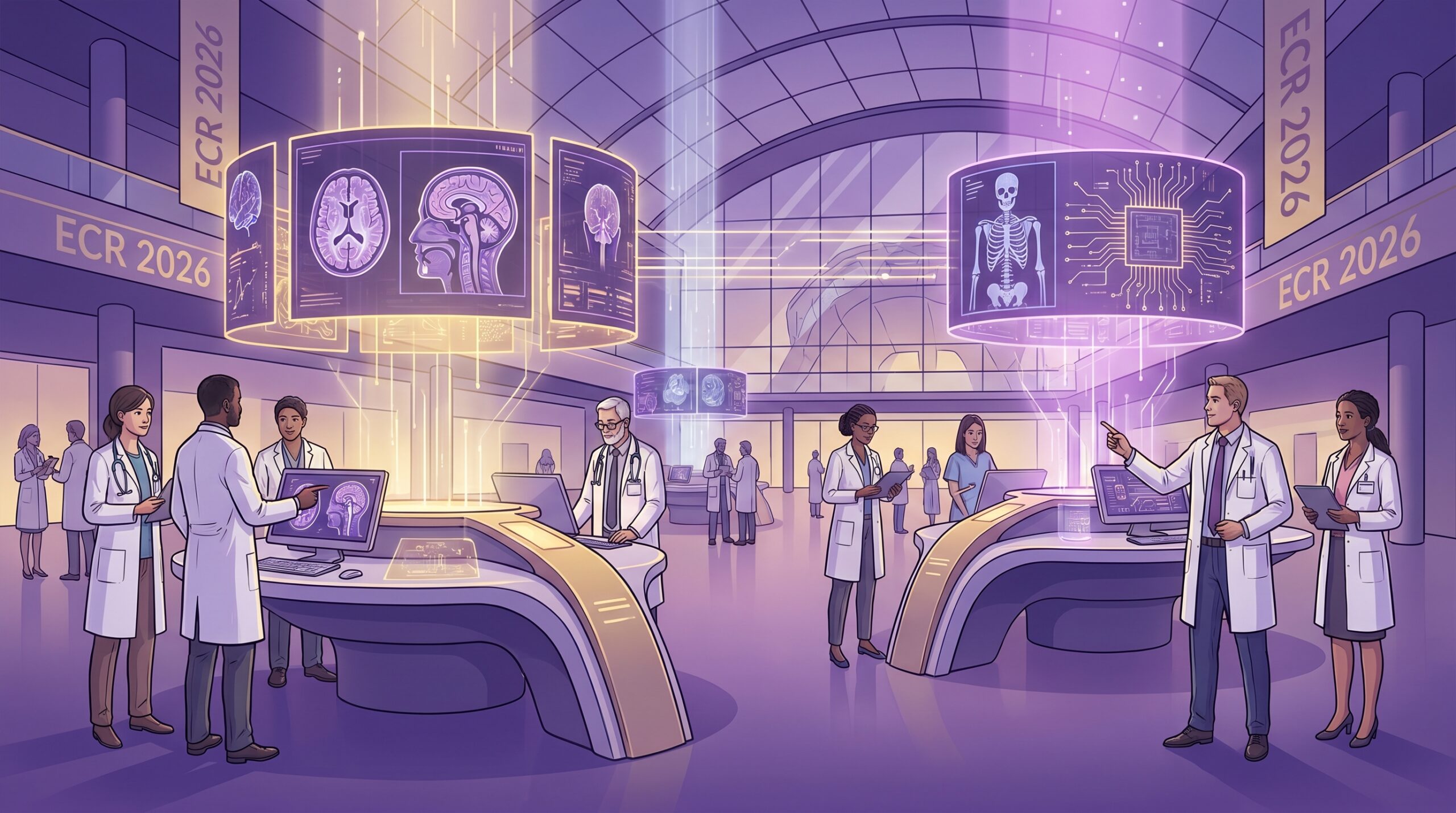
The European Congress of Radiology 2026, held March 4–8 in Vienna under Congress President Prof. Minerva Becker, broke its own records: 22,418 participants from 121 countries (a 9% increase over ECR 2025) and 11,376 submitted abstracts (a 15% increase). More than 220 companies exhibited the latest imaging technology, software, and services. The congress poster featured Athena, the Greek goddess of knowledge, embodying the theme’s celebration of learning and discovery in radiology.
In Focus: “The Art of AI in Clinical Practice”
ECR 2026’s In Focus program dedicated substantial programming to exploring how AI is transforming clinical radiology — with particular emphasis on the ethical, regulatory, and human dimensions often overshadowed by technical achievements. Sessions examined how AI is democratizing screening access, enhancing communication between radiologists and referring physicians, reshaping oncologic follow-up protocols, and creating new roles for radiologists in multidisciplinary care teams.
In a memorable plenary session, Dr. Nina Kottler and Dr. Charles Kahn examined the current challenges and opportunities in radiology AI, while Prof. Beets-Tan and Prof. Gouveia presented a visionary — and deliberately provocative — dialogue with an AI avatar about radiology in 2050, envisioning radiologists as “clinical orchestrators” who navigate fully reconstructed 3D patient models rather than scrolling through 2D image series. The ACR used ECR 2026 to launch its International ARCH-AI recognition program, promoting standardized quality AI adoption globally.
Scientific Highlights
The scientific program featured several notable contributions. The ESTI/ESR published practice recommendations for lung cancer screening with LDCT, which for the first time explicitly mandated deep learning algorithms for nodule detection and volumetric growth measurement in screening programs. Presentations on AI-powered stroke triage included updated meta-analyses demonstrating consistent workflow acceleration but persistent challenges in demonstrating clinical outcome improvement. The first-ever ECR Alzheimer’s Day highlighted the growing role of amyloid PET, tau PET, and AI-based brain morphometry in dementia diagnosis and therapeutic monitoring — increasingly relevant with the arrival of anti-amyloid immunotherapies.
New session formats enriched the educational experience. “Subspecialties on Stage” showcased the depth of subspecialty radiology. “Out of the Box” sessions explored imaging applications beyond medicine, including art conservation and archaeological analysis. “How We Do It: Fundamentals of Radiological Practice” emphasized practical experience-sharing over traditional lectures. “Decoding the Diagnosis: Radiology Meets Pathology” paired imaging findings with pathological correlates — a format praised for strengthening diagnostic confidence. The popular Imaging Interpretation Quizzes returned with competitive themes “Radiology Jeopardy” and “Sparta vs Athens.”
ECR 2026 attendees — record high, 121 countries
ECR 2026 abstracts submitted — all-time record (+15%)
New FDA AI/ML device authorizations in 2025 alone
Companies exhibiting at ECR 2026 technical exhibition
Industry and Technology Announcements
Both meetings showcased significant industry developments. At RSNA 2025, RapidAI’s five new FDA clearances expanded its enterprise platform into new clinical domains beyond stroke, including midline shift quantification and obstructive hydrocephalus detection. Multiple vendors demonstrated AI-accelerated MRI platforms, with Esaote launching its HyperSpeed AI module at ECR 2026 for significantly faster scan times while preserving image quality, alongside M-Score — a quantitative software for opportunistic bone health assessment during routine lumbar spine MRI. GE HealthCare unveiled the Allia Moveo next-generation interventional imaging system at ECR 2026, supporting the growing field of minimally invasive image-guided procedures.
The broader technology landscape reflected maturation rather than disruption. Vendors emphasized interoperability (PACS-integrated AI, FHIR-compatible data exchange), evidence generation (real-world validation, multicenter studies), and sustainable business models (demonstrated ROI, clear reimbursement pathways) rather than algorithmic novelty. This pragmatic orientation — what AI does for the radiologist today, not what it might do tomorrow — defined the industry tone at both meetings.
Guideline Updates and Regulatory Developments
Several important guideline updates were presented or published around the conference season. The ESTI/ESR lung cancer screening recommendations mandating AI were among the most impactful. The ACR launched its International ARCH-AI program and AI Central post-deployment monitoring platform. Discussions on the EU AI Act implementation timeline (high-risk classification effective August 2026) dominated regulatory sessions at ECR, with speakers emphasizing the need for radiology departments to prepare for documentation requirements around data curation, bias assessment, and human oversight.
In the US, FDA’s continued evolution toward life-cycle oversight for adaptive AI — including predetermined change control plans (PCCPs) that allow model updates without full resubmission — was a recurring topic at RSNA 2025. The ongoing absence of dedicated CPT codes for AI-aided radiology interpretations was identified as a key barrier to sustainable AI adoption, with legislative proposals under congressional consideration offering potential resolution. The field’s message to policymakers was clear: regulatory frameworks must balance safety with the need for continuous model improvement, and reimbursement must reflect the value AI adds to diagnostic quality and efficiency.
Shift from pilots to deployment. Measurable impact on reporting time, triage accuracy, and screening efficiency. Agentic AI emerging.
Imaging the individual. Multimodal data fusion. Opportunistic screening. Radiogenomics moving toward clinical translation.
AI literacy in curricula. “Clinical orchestrator” vision. Burnout reduction through automation. Workforce shortage mitigation.
EU AI Act preparation. Equity in AI access. Environmental footprint of imaging. Accountability frameworks for AI-aided diagnosis.
Future Directions
Both RSNA 2025 and ECR 2026 pointed toward a radiology landscape defined by integration — of AI into workflows, of imaging with other data modalities, of radiology with broader multidisciplinary care, and of innovation with sustainability and equity. The field is not reinventing itself overnight; it is evolving deliberately, guided by what clinicians, patients, and systems actually need. Looking ahead, the focus is less on bold promises and more on meaningful progress: proving that AI tools deliver measurable clinical and operational value, ensuring equitable access across practice settings, building regulatory and reimbursement frameworks that support sustainable innovation, and nurturing the next generation of radiologists who will be as comfortable evaluating model cards as they are interpreting MRI sequences.
Clinical Implications
For radiologists who didn’t attend RSNA 2025 or ECR 2026, the overarching takeaway is that the specialty’s direction is clear: integrated, data-driven, AI-augmented practice is no longer aspirational but operational. The key action items include engaging with AI tools in your practice setting (even if through pilots), investing in AI literacy through professional society CME offerings, advocating for equitable deployment of AI across practice types and geographies, and staying informed on regulatory developments — particularly the EU AI Act and evolving FDA frameworks — that will shape how AI is governed in your department. Both conferences confirmed that the radiologists who will thrive are those who view AI not as a threat to be resisted nor a panacea to be uncritically embraced, but as a powerful tool that requires informed stewardship to deliver on its promise.
References
- ESR. Attendance at record high as Rays of Knowledge illuminate radiology’s latest innovations at ECR 2026. ESR Press Release. March 11, 2026.
- ESR. ECR 2026: Rays of Knowledge to illuminate the education and innovation in radiology. ESR Press Release. February 2, 2026.
- ESR. ECR 2026 Programme: The Art of AI in Clinical Practice (In Focus). https://www.myesr.org/congress/programme/. Accessed March 2026.
- Becker M. Introducing Rays of Knowledge. ECR 2026 Congress President Address. March 2026.
- Beets-Tan R, Gouveia P. Enhanced by AI, but guided by humans: radiology’s vision for 2050. ECR 2026 Session. March 2026.
- RSNA. The future of radiology: AI’s transformative role in medical imaging (Langlotz, Kottler, Topol). RSNA 2025. January 2025.
- RadAI. 5 RSNA trends set to redefine radiology in 2026. December 2025.
- Definitive Healthcare. RSNA 2025 recap: AI and the future of radiology. December 2025.
- ACR. ACR leaders chart the future of radiology AI at ECR 2026. March 2026.
- RapidAI. FDA clearance of five new imaging modules. Press Release. November 25, 2025.
- IntuitionLabs. FDA’s AI medical device list: stats, trends, and regulation. 1,451 cumulative authorizations through end-2025. March 2026.
- Revel MP, Biederer J, Nair A, et al. ESR Essentials: lung cancer screening with low-dose CT — practice recommendations by the European Society of Thoracic Imaging. Eur Radiol. 2026;36:2064-2073.
- Esaote. ECR 2026: HyperSpeed AI module and M-Score launch. March 2026.
- ESR. Record-breaking abstract submission for ECR 2026: 9,742 abstracts in main phase (+14%); 11,376 total. October 2025 / January 2026.
- RadAI. RSNA 2025: Five trends shaping radiology’s next chapter. November 2025.
- DI Europe. ECR 2026 highlights education, AI, and global exchange in radiology. March 2026.
Disclaimer: This article summarizes publicly available information from ECR 2026 and RSNA 2025. Coverage is selective and does not represent a comprehensive account of all presentations. MedTrainHub has no financial relationship with ESR, RSNA, or any exhibitor mentioned.
Conflicts of Interest: None declared.
Suggested Citation: MedTrainHub Editorial Team. ECR 2026 and RSNA 2025 Highlights: What Radiologists Need to Know. MedTrainHub.com. April 2026.