Peer Review Status: Expert-reviewed | Last Updated: April 2026
Target Audience: Radiologists, Breast Imagers, Screening Program Directors, Oncologists
🔑 Key Takeaways
- Mirai (MIT/MGH): 5-year breast cancer risk prediction from mammography with C-index 0.76–0.81 across international cohorts — significantly outperforming Tyrer-Cuzick and Gail models.
- Nature Medicine 2026 trial (n=31,301): AI-supported screening reduced radiologist workload by 63.6% with 15.2% higher cancer detection rate (7.3 vs. 6.3 per 1,000).
- MASAI trial (Lancet Digital Health, 2025): AI triage contributed to early detection of clinically relevant breast cancer and reduced screen-reading workload without increasing false positives.
- Mirai can identify 42% of interval cancers by flagging the top 20% risk scores — potentially guiding supplemental imaging or shortened screening intervals.
- The field is moving from one-size-fits-all screening to AI-personalized risk-stratified screening with individualized intervals and modalities based on predicted risk.
Background
Breast cancer is the most commonly diagnosed cancer worldwide, with over 2.3 million new cases annually. Population-based mammography screening has been a cornerstone of early detection for four decades, reducing breast cancer mortality by an estimated 20–30% in screened populations [1]. However, current screening programs operate on a one-size-fits-all model — inviting all women in a specified age range (typically 50–74) for mammography at fixed intervals (annual or biennial), regardless of individual risk profiles. This approach results in significant over-screening of low-risk women (false positives, unnecessary biopsies, anxiety) and under-screening of high-risk women who develop interval cancers between scheduled screenings [2].
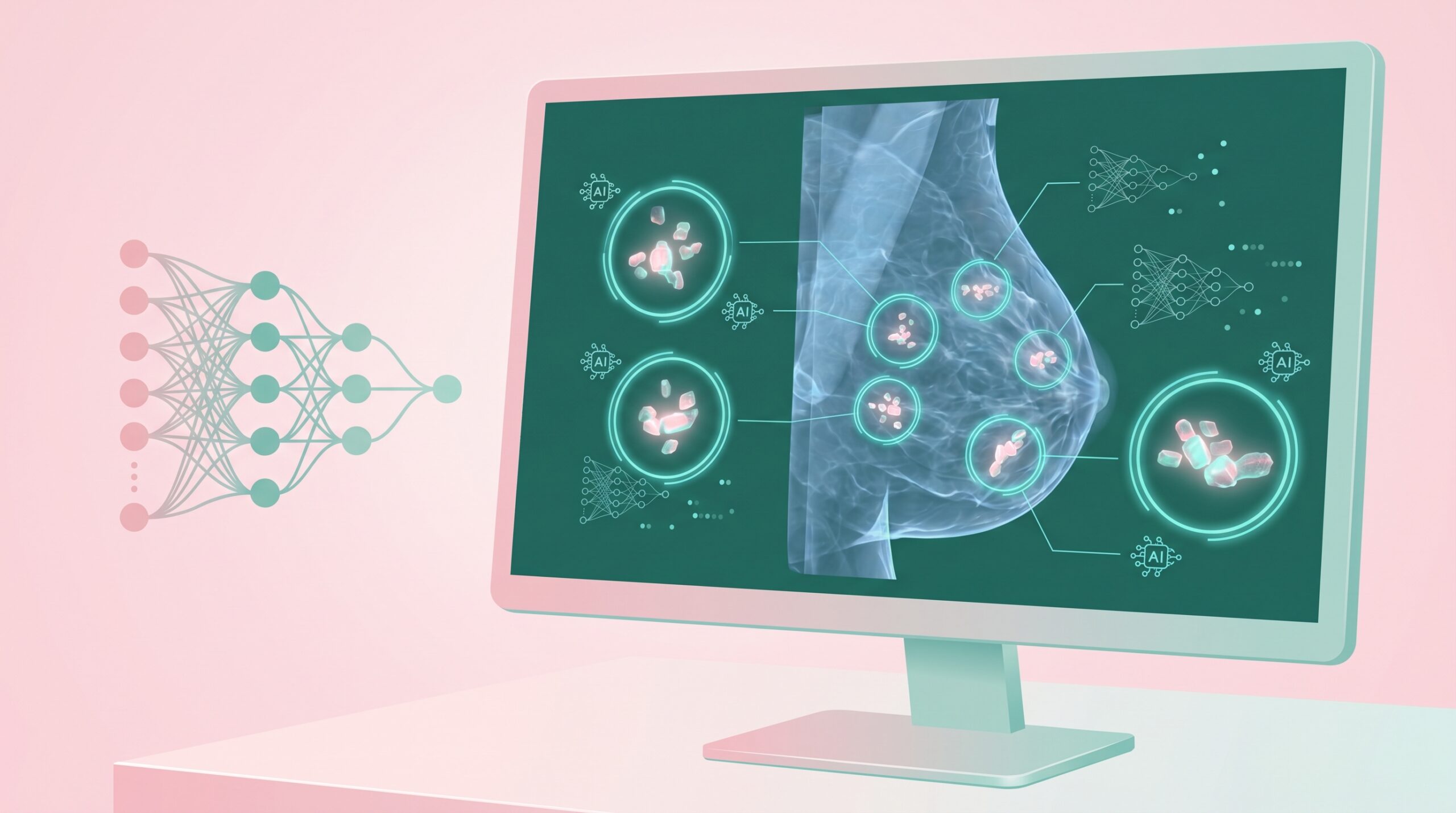
Deep learning algorithms applied to mammography are now challenging this paradigm from two complementary directions: improving the accuracy of cancer detection at the time of screening (diagnostic AI) and predicting individualized future breast cancer risk to guide personalized screening strategies (predictive AI). This review examines the evidence for both approaches, with emphasis on the landmark Mirai model and recent randomized trial data that together form the foundation for a new era of AI-personalized breast cancer screening in 2026.
Diagnostic AI: Improving Detection Accuracy
The Nature Medicine Trial (2026)
A prospective, paired, noninferiority clinical trial published in Nature Medicine in 2026 — the largest of its kind — evaluated whether AI could safely reduce radiologist workload in breast cancer screening without compromising cancer detection [3]. Between March 2022 and January 2024, 31,301 women underwent routine mammography screening, with two reading strategies applied in parallel:
- Standard strategy: Double-blind reading by two radiologists (the European gold standard).
- AI-supported strategy: Cases classified by AI as low-risk were assessed as normal (no radiologist reading needed); remaining cases were double-read with AI decision support.
The results were striking: the AI-supported strategy reduced radiologist workload by 63.6% while achieving a 15.2% higher cancer detection rate (7.3 per 1,000 vs. 6.3 per 1,000, p<0.001) compared with standard double reading [3]. The recall rate was 14.8% higher in the AI arm, which did not meet the prespecified noninferiority margin — raising important questions about the balance between sensitivity gains and increased recalls that will require further investigation.
The MASAI Randomized Trial
The Mammography Screening with Artificial Intelligence (MASAI) trial, published in The Lancet Digital Health in early 2025, was a randomized, controlled, parallel-group study evaluating AI-supported screening in a Swedish population-based program [4]. The trial demonstrated that AI triage contributed to earlier detection of clinically relevant breast cancer and reduced screen-reading workload without increasing false-positive rates — providing the first randomized evidence that AI can be safely integrated into organized screening programs.
Figure 1. AI-Supported Mammography Screening: Key Trial Results
Workload reduction
−63.6%
Radiologist reading
eliminated for low-risk cases
Detection rate increase
+15.2%
7.3 vs. 6.3 per 1,000
p<0.001
Women screened
31,301
Nature Medicine 2026
Prospective trial
Interval CA predicted
42%
Top 20% Mirai scores
identify interval cancers
Data from: Nature Medicine 2026 [3]; RSNA 2025 Mirai validation [5]; MASAI trial [4].
Predictive AI: Mirai and Risk-Stratified Screening
The Mirai Model
Mirai, developed by researchers at MIT’s Jameel Clinic and Massachusetts General Hospital, is a deep learning model that predicts individualized 1-to-5-year breast cancer risk directly from standard mammographic images — without requiring clinical risk factor inputs (age, family history, genetic markers) [6]. The model was trained on over 210,000 screening mammograms from MGH and has been validated across international cohorts:
- MGH (US): C-index 0.76 (95% CI 0.74–0.80)
- Karolinska (Sweden): C-index 0.81 (95% CI 0.79–0.82)
- Chang Gung (Taiwan): C-index 0.79 (95% CI 0.79–0.83)
Mirai significantly outperformed the Tyrer-Cuzick model (the most widely used clinical risk calculator) and prior deep learning approaches across all validation datasets (p<0.001 for all comparisons) [6]. Critically, Mirai performed consistently across racial and ethnic categories, addressing a key limitation of traditional risk models that were primarily developed and validated in White populations.
Predicting Interval Cancers
A landmark validation study presented at RSNA 2025 and published in Radiology evaluated Mirai’s ability to predict interval cancers — cancers diagnosed between negative screening mammograms — in the UK breast screening program [5]. The study processed over 130,000 negative digital screening mammograms through Mirai. Key findings:
- Women assigned the highest 1% of Mirai scores accounted for 3.6% of subsequent interval cancers.
- The top 5% accounted for 14.5% of interval cancers.
- The top 20% accounted for 42.4% of the 524 interval cancers detected.
These findings suggest that AI risk stratification could identify women who would benefit most from supplemental imaging (contrast-enhanced mammography, MRI) or shortened screening intervals — transforming breast cancer screening from a uniform population-based activity into a personalized, risk-adapted program [5].
Mirai and Mortality
A 2025 retrospective cohort study of 124,653 Korean women demonstrated that Mirai risk scores predicted not just breast cancer incidence but also breast cancer-specific mortality — with changes in Mirai scores over time also linked to mortality outcomes [7]. This finding elevates Mirai from a screening tool to a potential prognostic biomarker.
Table 1. Key AI Mammography Studies and Their Clinical Impact
| Study / Model | Application | N | Key Finding |
|---|---|---|---|
| Mirai (MIT/MGH) | 5-year risk prediction | 210,819 | C-index 0.76–0.81; outperforms Tyrer-Cuzick across diverse populations |
| Nature Medicine 2026 trial | AI triage + decision support | 31,301 | 63.6% workload reduction; 15.2% higher detection rate |
| MASAI trial (Sweden) | AI-supported screening | 80,000+ | Earlier detection of relevant cancer; reduced workload; no increase in false positives |
| UK triennial validation | Interval cancer prediction | 130,000+ | Top 20% Mirai scores capture 42% of interval cancers |
| Korean mortality study | Mortality prediction | 124,653 | Mirai scores predict breast cancer-specific mortality; serial changes also prognostic |
Sources: [3, 4, 5, 6, 7].
Toward Personalized Screening
The convergence of diagnostic AI (improving detection at each screening visit) and predictive AI (identifying who should be screened more or less frequently) opens the path to truly personalized breast cancer screening. The envisioned model replaces the current uniform approach with a risk-stratified system:
- Low risk (bottom 50% of Mirai scores): Extended screening interval (3 years instead of 2) or deferral of screening in younger women — reducing radiation exposure, false positives, and healthcare costs with minimal impact on cancer detection [8].
- Average risk: Standard biennial mammography with AI-assisted reading to improve accuracy.
- High risk (top 10–20% of Mirai scores): Shortened screening interval (annual), supplemental imaging (MRI or contrast-enhanced mammography), and/or risk-reducing interventions (chemoprevention, enhanced clinical surveillance) [5].
This approach aligns with the broader paradigm shift in cancer screening from population-based uniformity to precision prevention — a concept strongly endorsed by the Lancet Commission on breast cancer screening modernization and the European Commission Initiative on Breast Cancer [9].
Challenges and Limitations
- Recall rate trade-offs: The Nature Medicine trial’s AI arm detected more cancers but also recalled 14.8% more women. The clinical and psychological costs of increased false-positive recalls must be weighed against detection gains, particularly in settings where recall rates are already high (e.g., US vs. European programs) [3].
- Dense breast performance: Mirai showed reduced performance in women with extremely dense breast tissue, where mammography itself has lower sensitivity. Integration with supplemental modalities (tomosynthesis, MRI, contrast-enhanced mammography) will be critical for this population [5].
- Regulatory and implementation barriers: Transitioning from fixed-interval to risk-stratified screening requires changes in screening program infrastructure, regulatory frameworks, informed consent processes, and funding models. Most national screening programs are not yet structured to offer individualized intervals [10].
- Prospective outcome data: While Mirai’s risk prediction performance is well-validated, prospective randomized trials demonstrating that Mirai-guided screening reduces breast cancer mortality — the ultimate endpoint — have not yet been completed. Such trials are essential before widespread adoption [6].
- Explainability: A 2025 study published in Radiology: AI showed that Mirai’s predictions rely heavily on calcification features and subtle lesion characteristics — providing some interpretability, but the model remains largely a “black box” for clinical users [11].
Practical Guidance for Breast Imaging Programs
Figure 2. AI Integration Pathway for Breast Cancer Screening Programs
Start with AI-assisted triage (lowest barrier)
Deploy AI to pre-classify normal vs. abnormal mammograms. Radiologists focus on AI-flagged cases. Track concordance rates and false negative monitoring during initial deployment.
Add AI risk prediction (Mirai or equivalent)
Generate individualized 1-5-year risk scores at each screening visit. Use risk scores to recommend supplemental imaging for high-risk women. Report risk scores to referring physicians alongside screening results.
Pilot risk-stratified intervals (selected centers)
Offer shortened intervals (annual) or supplemental MRI for top-risk quartile. Extend intervals (triennial) for lowest-risk quartile with patient consent. Measure interval cancer rates, detection stage, and patient experience.
Evaluate outcomes and scale
Await mortality data from ongoing prospective trials. Perform cost-effectiveness analyses before system-wide implementation. Ensure equitable access across demographic and geographic populations. Address patient communication about AI-determined screening frequency.
Future Directions
Several developments are expected to accelerate AI adoption in breast cancer screening. Multimodal AI models that combine mammographic image features with clinical risk factors, breast density, and genetic information are showing improved performance over image-only models in early studies [12]. Foundation models for breast imaging — following the paradigm of general radiology foundation models — may enable transfer learning across imaging modalities and clinical tasks [13]. A foundation model specifically designed for breast and lung cancer screening was published in Nature Health in 2026, demonstrating the feasibility of cross-organ AI screening platforms [14].
From a policy perspective, the European Commission Initiative on Breast Cancer and several national screening programs (UK, Sweden, Netherlands) are actively evaluating the integration of AI into organized screening pathways, with pilot programs expected to inform policy decisions by 2027–2028. Economic modeling to assess the cost-effectiveness of AI-personalized screening versus fixed-interval programs is a critical prerequisite for policy change [10].
Clinical Implications
AI-powered mammography is transitioning from research validation to clinical implementation. For breast imaging programs, the evidence now supports deploying AI-assisted triage to improve detection accuracy and reduce radiologist workload — with the Nature Medicine trial providing the strongest prospective evidence to date. The Mirai model and its validated ability to predict interval cancers offer a scientifically sound basis for moving toward risk-stratified screening, though prospective mortality outcome data remain essential before widespread adoption of individualized screening intervals.
Clinicians should advocate for institutional adoption of AI-assisted mammography reading while maintaining vigilance about recall rate trade-offs, dense breast performance limitations, and the need for equitable access across diverse populations. The ultimate goal — reducing breast cancer mortality while minimizing screening harms — requires a careful, evidence-based transition from uniform to personalized screening, guided by data rather than enthusiasm [15, 16].
📚 Related Articles on MedTrainHub
References
- Independent UK Panel on Breast Cancer Screening. The benefits and harms of breast cancer screening: an independent review. Lancet. 2012;380(9855):1778-1786. doi:10.1016/S0140-6736(12)61611-0
- Kuhl CK. Breast cancer screening. Invest Radiol. 2026;61(3):205-213. doi:10.1097/RLI.0000000000001216
- Elías-Cabot E, et al. AI-based triage and decision support in mammography and digital tomosynthesis for breast cancer screening: a paired, noninferiority trial. Nat Med. 2026;advance online. doi:10.1038/s41591-026-04277-x
- MASAI Investigators. Screening performance and characteristics of breast cancer detected in the MASAI trial. Lancet Digit Health. 2025;7(2):e120-e130. doi:10.1016/S2589-7500(24)00267-X
- Rothwell E, et al. Evaluation of a mammography-based deep learning model for breast cancer risk prediction in a triennial screening program. Radiology. 2025;317(3):e250391. doi:10.1148/radiol.250391
- Yala A, et al. Toward robust mammography-based models for breast cancer risk. Sci Transl Med. 2021;13(578):eaba4373. doi:10.1126/scitranslmed.aba4373
- Shin S, et al. Deep learning mammography-based breast cancer risk model, its serial change, and breast cancer mortality. Breast Cancer. 2025;32(6):1462-1471. doi:10.1007/s12282-025-01772-w
- Bernstein MH, et al. A novel statistical framework for quantifying risks and benefits of AI automation in screening mammography. PLOS Digit Health. 2026;5(2):e0001231. doi:10.1371/journal.pdig.0001231
- European Commission Initiative on Breast Cancer. Recommendations on breast cancer screening. Published 2025. healthcare-quality.jrc.ec.europa.eu
- Mendes J, et al. Deep learning in breast cancer risk prediction: a review of recent applications in full-field digital mammography. Front Oncol. 2025;15:1656842. doi:10.3389/fonc.2025.1656842
- Grimm LJ, et al. Using explainable AI to characterize features in the Mirai mammographic breast cancer risk prediction model. Radiology: AI. 2025;7(4):e240417. doi:10.1148/ryai.240417
- Park JH, et al. AI-powered imaging biomarker based on mammography for breast cancer risk prediction. Cancers. 2024;16(12):2254. doi:10.3390/cancers16122254
- MIT Jameel Clinic. At RSNA 2025, Mirai is changing breast cancer screening. Published December 2025. jclinic.mit.edu
- Qian X, et al. A foundation model for breast and lung cancer screening using non-contrast computed tomography. Nat Health. 2026;advance online. doi:10.1038/s44360-026-00055-8
- RSNA. AI tool identifies women at high risk of interval breast cancer. Published October 2025. rsna.org/news
- Akter L, et al. Artificial intelligence for breast cancer detection: trends, challenges, and future directions. Nano Theragnostics in Breast Cancer. 2026:707-750. doi:10.1007/978-981-95-3682-5_19
Disclaimer: This article is intended for healthcare professionals and is provided for educational purposes only. It does not constitute medical advice. Clinical decisions should be based on individual patient assessment and current clinical guidelines. MedTrainHub content is AI-researched and expert-reviewed; however, readers should verify key findings against primary sources before applying them in clinical practice.
Conflicts of Interest: None declared.
Funding: This article received no external funding.
Citation: MedTrainHub Editorial Team. Deep Learning for Mammography: Personalized Breast Cancer Screening. MedTrainHub.com. Published April 2026. Available at: https://medtrainhub.com/articles/radiology/ai-mammography-breast-cancer-screening