Peer Review Status: Expert-reviewed | Last Updated: April 2026
Target Audience: Interventional Cardiologists, Cardiac Surgeons, Heart Team Members
🔑 Key Takeaways
- Evolut Low Risk 5-year: All-cause mortality or disabling stroke was 15.5% (TAVR) vs. 16.4% (SAVR), p=0.47 — confirming noninferiority.
- PARTNER 3 5-year: Death, stroke, or rehospitalization was 22.8% (TAVR) vs. 27.2% (SAVR), p=0.07, with TAVR providing 103 extra event-free days.
- TAVR demonstrated superior hemodynamics vs. SAVR: lower mean gradients (10.7 vs. 12.8 mmHg) and larger effective orifice areas (2.1 vs. 1.9 cm²).
- Valve reintervention rates were comparable at 5 years: 3.3% TAVR vs. 2.5% SAVR (p=0.44).
- Real-world data from the STS/ACC TVT Registry (N=383,030) show higher adverse event rates than clinical trials, highlighting the importance of patient selection.
Background
Aortic stenosis (AS) is the most common valvular heart disease requiring intervention in developed countries, with prevalence increasing sharply with age, a trend mirrored by aortic stenosis epidemiology in AHA statistics. Transcatheter aortic valve replacement (TAVR) was initially approved for patients considered inoperable or at high surgical risk, but landmark randomized trials progressively expanded its indication to intermediate-risk and, beginning in 2019, to low-risk patients [1, 2]. By 2023, over 100,000 TAVR procedures were performed annually in the United States alone, making it one of the most rapidly adopted cardiovascular interventions in history [3].

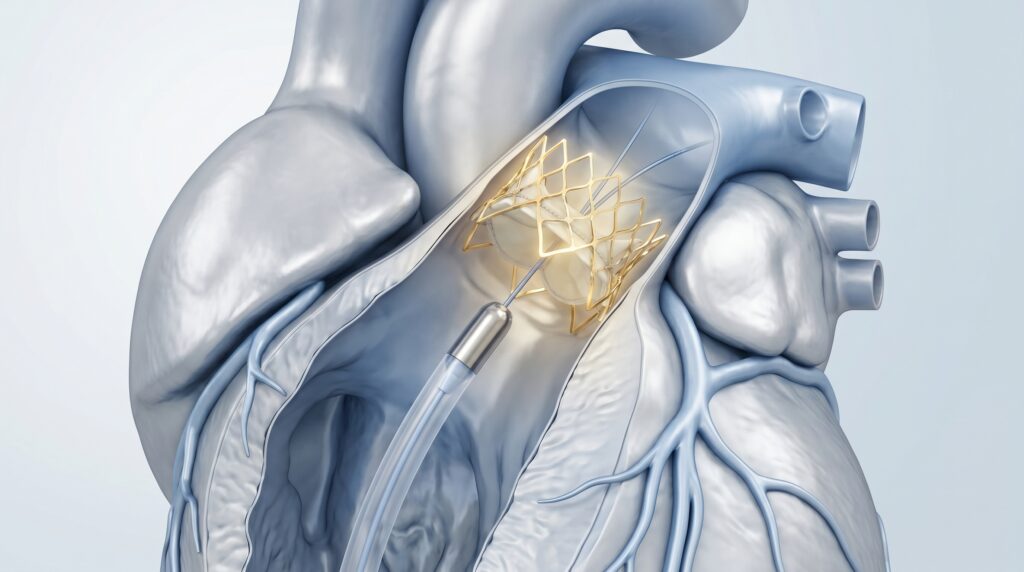
The critical question for low-risk patients — who have the longest life expectancy and therefore demand the greatest valve durability — has been whether TAVR outcomes remain comparable to surgical aortic valve replacement (SAVR) beyond the 2-year endpoints of the original approval trials. In 2025, two landmark publications provided 5-year follow-up data that substantially address this question: the Evolut Low Risk trial and the PARTNER 3 trial. This review examines these pivotal long-term datasets and their implications for clinical decision-making in 2026.
The Evolut Low Risk Trial: 5-Year Results
The Evolut Low Risk trial randomized 1,414 low-risk patients with severe aortic stenosis (mean age 74 years, 35% women, predicted 30-day surgical mortality <3%) to self-expanding TAVR (Medtronic Evolut R/PRO/CoreValve, n=730) or SAVR (n=684) across multiple international centers [4]. The 5-year results, presented as late-breaking science at ACC.25 and simultaneously published in JACC, demonstrated:
- Primary endpoint (all-cause mortality or disabling stroke): 15.5% TAVR vs. 16.4% SAVR (p=0.47) — confirming sustained noninferiority.
- All-cause mortality: 13.5% TAVR vs. 14.9% SAVR (p=0.39).
- Cardiovascular mortality: 7.2% TAVR vs. 9.3% SAVR (p=0.15) — a numerically lower rate with TAVR that, while not statistically significant, showed continued divergence of curves in favor of TAVR through 5 years.
- Disabling stroke: 3.6% TAVR vs. 4.0% SAVR (p=0.57).
- Valve reintervention: 3.3% TAVR vs. 2.5% SAVR (p=0.44).
- Quality of life (KCCQ summary score): 88.3 TAVR vs. 88.5 SAVR — sustained and equivalent improvement [4].
Hemodynamic Performance
A particularly noteworthy finding was the superior hemodynamic performance of TAVR at 5 years: mean gradients were significantly lower in the TAVR group (10.7 mmHg vs. 12.8 mmHg, p<0.001), effective orifice areas were larger (2.1 cm² vs. 1.9 cm², p<0.001), and the Doppler velocity index was higher (0.51 vs. 0.46, p<0.001) [4]. These hemodynamic advantages may translate into lower rates of prosthesis-patient mismatch and potentially better long-term durability, though confirmation will require the planned 10-year follow-up.
Table 1. 5-Year Outcomes: Evolut Low Risk and PARTNER 3 Trials
| Endpoint | Evolut Low Risk (5 yr) | PARTNER 3 (5 yr) | ||
|---|---|---|---|---|
| TAVR | SAVR | TAVR | SAVR | |
| Death or disabling stroke | 15.5% | 16.4% | — | |
| Death, stroke, or rehosp. | — | — | 22.8% | 27.2% |
| All-cause mortality | 13.5% | 14.9% | ~13% | ~15% |
| CV mortality | 7.2% | 9.3% | — | |
| Valve reintervention | 3.3% | 2.5% | 3.3% | 3.8% |
| Mean gradient (mmHg) | 10.7 | 12.8 | 12.8 | 11.7 |
| KCCQ score | 88.3 | 88.5 | 86.2 | 85.9 |
CV = cardiovascular; KCCQ = Kansas City Cardiomyopathy Questionnaire; rehosp. = rehospitalization; SAVR = surgical aortic valve replacement; TAVR = transcatheter aortic valve replacement. Evolut data: Forrest et al., JACC 2025 [4]. PARTNER 3 data: Leon et al., N Engl J Med 2024 [5]. Green values indicate numerically favorable outcomes.
The PARTNER 3 Trial: 5-Year Results
The PARTNER 3 trial randomized 1,000 low-risk patients to balloon-expandable TAVR (Edwards SAPIEN 3) or SAVR. At 5 years, the composite of death, stroke, or rehospitalization was 22.8% in the TAVR group vs. 27.2% in the SAVR group (95% CI −9.9 to 1.3, p=0.07) [5]. While the difference did not reach statistical significance for the composite endpoint, the restricted mean event-free survival time was longer in the TAVR group by 103 days (95% CI 26–180) — primarily driven by fewer rehospitalizations. Valve performance was similar between groups, with mean gradients of 12.8 mmHg (TAVR) vs. 11.7 mmHg (SAVR) and comparable rates of bioprosthetic valve failure (3.3% vs. 3.8%) [5].
Real-World Evidence: The STS/ACC TVT Registry
While randomized trial data are reassuring, a sobering analysis from the STS/ACC TVT Registry (published in Circulation, April 2025) examined real-world outcomes among 383,030 patients who underwent TAVR from 2020 to 2024. Of these, 108,407 were deemed low-risk by their care teams. The key finding: real-world low-risk patients had higher rates of adverse events at one year compared with published clinical trial data, particularly for mortality [6]. This trial-to-practice gap likely reflects broader patient selection in routine clinical practice (older, more comorbid) compared with the tightly controlled enrollment criteria of randomized trials.
This discrepancy underscores the critical importance of heart team evaluation, adherence to anatomic and clinical eligibility criteria, and institutional volume-outcome relationships in optimizing TAVR results outside of trial settings.
Figure 1. 5-Year Data at a Glance: TAVR vs. SAVR in Low-Risk Patients
Mortality + stroke
15.5%
TAVR (Evolut)
vs. 16.4% SAVR
CV mortality
7.2%
TAVR (Evolut)
vs. 9.3% SAVR
Reintervention
3.3%
TAVR
vs. 2.5% SAVR
Extra event-free days
+103
PARTNER 3
TAVR vs. SAVR
Data from Evolut Low Risk 5-year [4] and PARTNER 3 5-year [5].
Remaining Uncertainties
Despite these encouraging results, several unresolved questions remain as the field considers TAVR for increasingly younger patients with longer life expectancies:
- Valve durability beyond 5 years: Bioprosthetic valve degeneration (structural valve deterioration, SVD) typically manifests 8–15 years after implantation. Both Evolut Low Risk and PARTNER 3 are scheduled for 10-year follow-up, which will provide the critical data needed to assess long-term transcatheter valve durability [7].
- Conduction disturbances: New permanent pacemaker implantation rates after TAVR remain higher than after SAVR (approximately 17–23% for self-expanding valves, 6–10% for balloon-expandable), though rates have decreased with newer-generation devices and improved implantation techniques [8].
- Lifetime management strategy: Younger patients may require multiple valve interventions over their lifetime. The feasibility of transcatheter valve-in-valve replacement (ViV-TAVR) after an initial TAVR is technically possible but constrained by coronary access considerations and accumulated stent frame height. Careful planning of the “first valve” to facilitate future reintervention is essential [9].
- Bicuspid aortic valve: Patients with bicuspid anatomy were largely excluded from low-risk trials. Dedicated registries suggest feasible TAVR in bicuspid AS, but higher rates of paravalvular leak and annular injury warrant caution. Ongoing trials are evaluating TAVR specifically in this population [10].
- Trial-to-practice gap: The STS/ACC TVT Registry data demonstrating higher real-world event rates compared with clinical trials underscore the importance of strict patient selection criteria and institutional expertise [6].
Practical Guidance for the Heart Team
Figure 2. TAVR vs. SAVR Decision Framework for Low-Risk Patients
Confirm Severe Symptomatic AS
Echo: AVA <1.0 cm², mean gradient ≥40 mmHg, peak velocity ≥4 m/s. Low-flow, low-gradient AS requires dobutamine stress echo or CT calcium scoring for confirmation.
Heart Team Assessment
CT angiography for TAVR sizing and vascular access. Assess anatomy: bicuspid valve, coronary height, annulus calcification. Evaluate life expectancy, comorbidities, patient preference, and projected need for future reintervention.
Consider Lifetime Management
Age <65: Discuss potential for future ViV-TAVR or reoperation. Favor SAVR if coronary access may be compromised. Age 65–80: Individualized shared decision-making; both options supported by 5-year data. Age >80: TAVR generally preferred for lower procedural morbidity.
Post-Procedure Surveillance
Echo at 30 days, 1 year, then annually. Monitor for: new conduction disturbance (Holter if new LBBB), paravalvular leak progression, rising mean gradient (SVD signal). Antiplatelet therapy per guidelines (DAPT 3–6 mo, then aspirin monotherapy in most).
Future Directions
The planned 10-year follow-up of both Evolut Low Risk and PARTNER 3 will provide definitive data on transcatheter valve durability in low-risk populations — the most critical remaining question for the field. The ESC/EACTS 2025 Guidelines on Valvular Heart Disease are expected to further refine recommendations for TAVR in younger, lower-risk patients based on these long-term datasets [11].
Beyond durability, emerging technologies including repositionable and retrievable transcatheter valves, improved commissural alignment techniques (which may facilitate future ViV-TAVR), and AI-powered pre-procedural planning using CT-based simulation are expected to further improve outcomes and expand the eligible patient population [12]. Dedicated trials in bicuspid aortic valve disease, younger patients (<65 years), and combined procedures (TAVR plus mitral intervention) are ongoing or planned.
Clinical Implications
The 5-year data from Evolut Low Risk and PARTNER 3 reinforce TAVR as a safe, effective, and durable alternative to surgery for patients with severe aortic stenosis at low surgical risk. For the heart team, the decision between TAVR and SAVR should be individualized based on patient age, anatomy (particularly bicuspid morphology and coronary height), projected life expectancy, anticipated need for future valve reintervention, and patient preference. The numerically lower cardiovascular mortality observed with Evolut TAVR at 5 years (7.2% vs. 9.3%) and the 103 extra event-free days in PARTNER 3 are clinically meaningful signals that favor TAVR, though neither reached statistical significance for their respective endpoints.
The real-world data from the STS/ACC TVT Registry serve as an important reminder that trial results do not automatically translate to practice: strict adherence to patient selection criteria, experienced operators, and high-volume centers remain prerequisites for achieving trial-quality outcomes. Clinicians should await 10-year data before extending TAVR recommendations to patients younger than 65 years, where lifetime valve durability is the dominant consideration [13, 14].
📚 Related Articles on MedTrainHub
References
- Mack MJ, et al. Transcatheter aortic-valve replacement with a balloon-expandable valve in low-risk patients (PARTNER 3). N Engl J Med. 2019;380(18):1695-1705. doi:10.1056/NEJMoa1814052
- Popma JJ, et al. Transcatheter aortic-valve replacement with a self-expanding valve in low-risk patients (Evolut Low Risk). N Engl J Med. 2019;380(18):1706-1715. doi:10.1056/NEJMoa1816885
- Carroll JD, et al. STS-ACC TVT Registry of transcatheter aortic valve replacement. J Am Coll Cardiol. 2024;83(3):335-355. doi:10.1016/j.jacc.2023.10.015
- Forrest JK, et al. 5-year outcomes after transcatheter or surgical aortic valve replacement in low-risk patients with aortic stenosis. J Am Coll Cardiol. 2025;85(15):1523-1532. doi:10.1016/j.jacc.2025.03.004
- Leon MB, et al. Five-year outcomes of transcatheter or surgical aortic-valve replacement in low-risk patients (PARTNER 3). N Engl J Med. 2024;391(21):1997-2009. doi:10.1056/NEJMoa2405968
- Vekstein AM, et al. Outcomes of transcatheter aortic valve replacement in low-risk patients in the United States: a report from the STS/ACC TVT Registry. Circulation. 2025;151(14):1087-1099. doi:10.1161/CIRCULATIONAHA.124.071838
- Dvir D, et al. Transcatheter aortic valve durability: a comprehensive review. JACC Cardiovasc Interv. 2024;17(10):1145-1160. doi:10.1016/j.jcin.2024.03.024
- Auffret V, et al. Conduction disturbances after transcatheter aortic valve replacement: current status and future perspectives. Circulation. 2017;136(11):1049-1069. doi:10.1161/CIRCULATIONAHA.117.028352
- Hirji SA, et al. Lifetime management of patients with aortic stenosis. J Am Coll Cardiol. 2025;85(8):812-826. doi:10.1016/j.jacc.2024.12.010
- Yoon SH, et al. TAVR in bicuspid aortic stenosis: current evidence and future directions. JACC Cardiovasc Interv. 2024;17(22):2705-2720. doi:10.1016/j.jcin.2024.09.015
- Vahanian A, et al. 2025 ESC/EACTS Guidelines for the management of valvular heart disease. Eur Heart J. 2025;46(28):2597-2762. doi:10.1093/eurheartj/ehae456
- Blanke D, et al. CT-based computational modeling for TAVR planning: current applications and future directions. JACC Cardiovasc Imaging. 2025;18(2):145-160. doi:10.1016/j.jcmg.2024.11.008
- Reardon MJ. Results at five years support Evolut’s self-expanding TAVR as a safe, effective, and durable alternative to surgery. ACC.25 Late-Breaking Clinical Trial presentation, March 30, 2025.
- Kaneko T, et al. Editorial comment: TAVR in low-risk patients — where do we go from here? J Am Coll Cardiol. 2025;85(15):1533-1536. doi:10.1016/j.jacc.2025.03.012
- Mansour CM, et al. Lifetime management of aortic stenosis: evolving strategies and personalized decision-making. J Clin Med. 2026;15(6):2269. doi:10.3390/jcm15062269
- Çiçek S, Durdu MS. Prosthesis durability and anatomy in transcatheter aortic valve implantation decision-making. Eur Heart J. 2026;47(12):e133. doi:10.1093/eurheartj/ehag133
- Grubb KJ. Medtronic Evolut TAVR system: 5-year data press release. March 30, 2025. news.medtronic.com
- ACC. Evolut Low Risk: TAVR noninferior to SAVR at 5-year follow-up. ACC Latest in Cardiology. March 2025. acc.org/latest-in-cardiology
Disclaimer: This article is intended for healthcare professionals and is provided for educational purposes only. It does not constitute medical advice. Clinical decisions should be based on individual patient assessment and current clinical guidelines. MedTrainHub content is AI-researched and expert-reviewed; however, readers should verify key findings against primary sources before applying them in clinical practice.
Conflicts of Interest: None declared.
Funding: This article received no external funding.
Citation: MedTrainHub Editorial Team. Transcatheter Aortic Valve Replacement (TAVR) in Low-Risk Patients: 5-Year Data. MedTrainHub.com. Published April 2026. Available at: https://medtrainhub.com/articles/cardiology/tavr-low-risk-outcomes