Peer Review Status: Expert-reviewed | Last Updated: April 2026
Target Audience: Cardiologists, Interventional Cardiologists, Hypertension Specialists
🔑 Key Takeaways
- Second-generation sham-controlled trials (SPYRAL HTN-ON MED, RADIANCE II) demonstrate consistent office SBP reductions of 5–9 mmHg and ambulatory SBP reductions of 4–7 mmHg vs. sham.
- The RADIANCE II trial (n=224) showed a 7.9 mmHg reduction in daytime ambulatory SBP at 2 months with ultrasound RDN (p<0.001).
- 3-year follow-up data confirm durable blood pressure reductions without significant late safety signals.
- FDA granted Breakthrough Device Designation to the Paradise ultrasound RDN system; European and Asian regulatory approvals have been granted for multiple devices.
- Optimal candidates: patients with true resistant hypertension (uncontrolled on ≥3 agents including a diuretic) or documented medication non-adherence/intolerance.
Background
Hypertension affects an estimated 1.3 billion adults worldwide and remains the single largest modifiable risk factor for cardiovascular death, stroke, heart failure, and chronic kidney disease [1]. This burden is also reflected in hypertension prevalence in AHA 2026 statistics. Despite the availability of numerous effective antihypertensive drug classes, approximately 10–15% of treated hypertensive patients have resistant hypertension — defined as blood pressure that remains above target despite concurrent use of three or more antihypertensive agents at optimal doses, including a diuretic [2].

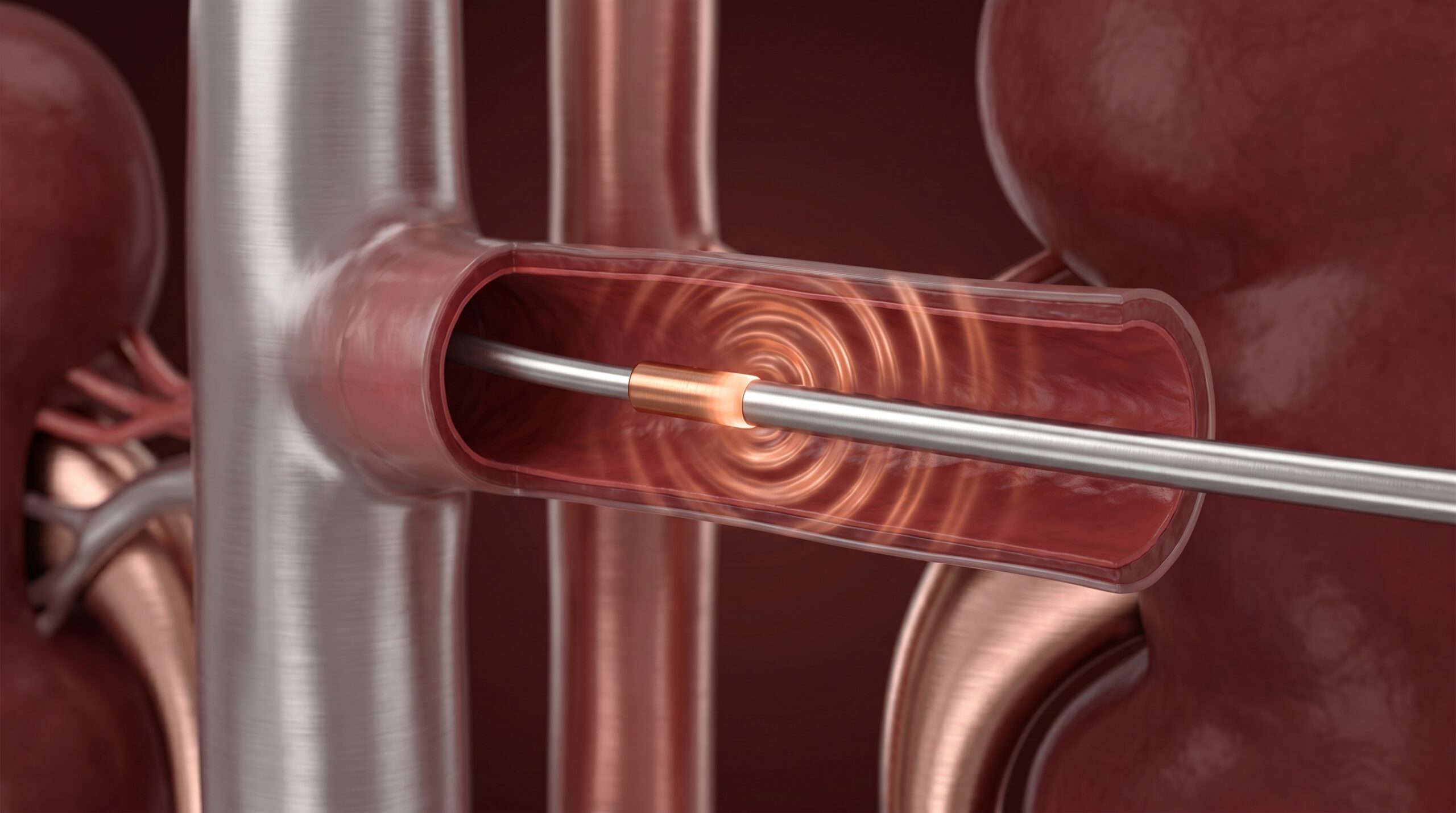
Renal denervation (RDN) — catheter-based ablation of the renal sympathetic nerves — emerged in the early 2010s as a promising device-based therapy for resistant hypertension. However, the field suffered a major setback in 2014 when the SYMPLICITY HTN-3 trial, the first large sham-controlled study, failed to demonstrate a significant difference in blood pressure reduction between RDN and sham procedures [3]. In the decade since, rigorous re-evaluation of trial design, patient selection, procedural technique, and device technology has led to a remarkable comeback. This review examines the current evidence base for RDN, its regulatory status, and practical guidance for clinicians considering this therapy in 2026.
Why SYMPLICITY HTN-3 Failed — and What Changed
The failure of SYMPLICITY HTN-3 to meet its primary endpoint prompted extensive post-hoc analyses that identified several methodological and procedural issues:
- Medication changes: Uncontrolled medication adjustments during the trial confounded blood pressure outcomes, with many sham-group patients receiving intensified pharmacotherapy.
- Procedural inconsistency: Many operators had limited RDN experience, and ablation completeness varied widely. The procedure was often limited to the main renal artery rather than including distal branches and accessories.
- Patient selection: Inadequate screening for pseudo-resistance (medication non-adherence, white-coat hypertension) diluted the treatment effect.
- Device limitations: The first-generation Symplicity catheter delivered radiofrequency energy to the main renal artery only, potentially missing nerve fibers in the distal vasculature [4].
Second-generation trials addressed each of these issues: standardized medication protocols (including supervised drug washout or fixed-dose regimens), mandated operator training with minimum procedural volumes, strict ambulatory blood pressure monitoring (ABPM) criteria for enrollment, and next-generation devices designed for circumferential, multi-point ablation of both proximal and distal renal artery segments [5].
Pivotal Second-Generation Trial Data
SPYRAL HTN Program (Radiofrequency)
The SPYRAL HTN trial program evaluated the Medtronic Symplicity Spyral multi-electrode radiofrequency catheter in a series of sham-controlled studies. SPYRAL HTN-OFF MED examined RDN in patients who underwent medication washout, demonstrating significant ambulatory SBP reductions of 3.9 mmHg at 3 months (p=0.005) in the absence of any antihypertensive medication [6]. SPYRAL HTN-ON MED evaluated RDN as an adjunct to stable antihypertensive therapy, showing 24-hour ambulatory SBP reductions of 7.0 mmHg vs. sham at 6 months in the expanded cohort (p<0.001) [7].
RADIANCE Program (Ultrasound)
The RADIANCE trials evaluated the ReCor Medical Paradise endovascular ultrasound RDN system. RADIANCE-HTN SOLO (n=146, off-medication design) demonstrated 6.3 mmHg daytime ambulatory SBP reduction at 2 months (p=0.001) [8]. The larger RADIANCE II trial (n=224, on-medication design) showed 7.9 mmHg reduction in daytime ambulatory SBP at 2 months in patients with combined hypertension (p<0.001) [9]. The ultrasound approach delivers circumferential energy to both proximal and distal segments, potentially achieving more complete nerve ablation.
Long-Term Durability
Three-year follow-up data from both the SPYRAL and RADIANCE programs demonstrate durable blood pressure reductions, with sustained or even increasing BP-lowering effects over time. In RADIANCE-HTN SOLO, the ambulatory SBP reduction persisted at 36 months (−8.5 mmHg from baseline), and long-term safety data showed no evidence of renal artery stenosis, decline in eGFR, or other significant vascular complications [10].
Table 1. Key Sham-Controlled Renal Denervation Trials
| Trial | Device / Energy | N | Design | Δ Amb. SBP vs Sham | Follow-up |
|---|---|---|---|---|---|
| SYMPLICITY HTN-3 | Symplicity Flex / RF | 535 | On-med, sham-controlled | −2.0 (NS) | 6 mo |
| SPYRAL HTN-OFF MED | Spyral / RF (multi-electrode) | 331 | Off-med, sham-controlled | −3.9 (p=0.005) | 3 mo |
| SPYRAL HTN-ON MED | Spyral / RF (multi-electrode) | 337 | On-med, sham-controlled | −7.0 (p<0.001) | 6 mo |
| RADIANCE-HTN SOLO | Paradise / Ultrasound | 146 | Off-med, sham-controlled | −6.3 (p=0.001) | 2 mo |
| RADIANCE II ⭐ | Paradise / Ultrasound | 224 | On-med, sham-controlled | −7.9 (p<0.001) | 2 mo |
Amb. = ambulatory; mo = months; NS = not significant; RF = radiofrequency; SBP = systolic blood pressure. ⭐ = largest on-medication ultrasound RDN trial. All second-generation trials used mandatory ABPM endpoints, standardized medication protocols, and trained operators. Sources: [3, 6, 7, 8, 9].
Figure 1. Renal Denervation: From Controversy to Comeback
2014
HTN-3 fails
Sham-controlled trial
no significant ΔBP
2015–2019
Redesign era
New devices, strict
trial methodology
2020–2023
Vindication
SPYRAL & RADIANCE
positive results
2024–2026
Clinical adoption
EU/Asia approvals
FDA review ongoing
Adapted from ACC Cardiology Magazine, April 2026 [11] and ESC/ESH 2023 Hypertension Guidelines [2].
Regulatory Status
The regulatory landscape for RDN varies by geography. The ReCor Medical Paradise ultrasound system has received CE Mark approval in Europe and regulatory clearance in several Asian markets. In the United States, the FDA granted Breakthrough Device Designation to the Paradise system, and a Premarket Approval (PMA) application was submitted in 2024 based on the combined RADIANCE trial program data [12]. The Medtronic Symplicity Spyral system has also received CE Mark approval. As of April 2026, FDA review of both devices is ongoing, with a regulatory decision anticipated in the near term.
Patient Selection
Appropriate patient selection is critical to achieving meaningful blood pressure reductions with RDN. Based on current trial evidence and expert consensus, the optimal candidates include [2, 11, 13]:
- True resistant hypertension: Uncontrolled BP (office SBP ≥140 mmHg or 24-hour ambulatory SBP ≥130 mmHg) despite ≥3 optimally dosed antihypertensives including a diuretic, confirmed by ABPM.
- Medication non-adherence or intolerance: Patients who cannot tolerate adequate pharmacotherapy due to side effects (e.g., ACE inhibitor cough, beta-blocker fatigue, diuretic metabolic effects) or who have documented non-adherence by drug level monitoring.
- Patient preference: Some patients strongly prefer a procedural approach to reduce pill burden, particularly those taking ≥5 antihypertensive medications.
Patients should be excluded if they have secondary hypertension (e.g., pheochromocytoma, renal artery stenosis >50%, primary aldosteronism not adequately screened), eGFR <40 mL/min/1.73 m², unsuitable renal artery anatomy (main artery diameter <3 mm or length <20 mm), prior renal artery intervention, or type 1 diabetes mellitus [13].
Safety Profile
Across all second-generation trials, the procedural safety profile of RDN has been favorable. The most common periprocedural adverse events include:
- Access site complications: Groin hematoma (2–3%), pseudoaneurysm (<1%), consistent with standard femoral catheterization procedures.
- Renal artery effects: Mild, transient vessel spasm during the procedure. No cases of significant renal artery stenosis at 3-year follow-up in either SPYRAL or RADIANCE programs [10].
- Renal function: No significant decline in eGFR observed at 36-month follow-up. In some studies, eGFR was marginally better preserved in the RDN group, likely reflecting improved blood pressure control [10].
Practical Considerations
Figure 2. RDN Patient Pathway: Pre-Procedure to Follow-Up
Confirm True Resistance
24-hour ABPM (not office BP alone). Verify medication adherence (urine/blood drug levels if available). Exclude secondary causes: renal artery duplex, aldosterone/renin ratio, catecholamines.
Multidisciplinary Evaluation
Hypertension specialist review. Renal artery CT angiography for anatomy assessment (diameter ≥3 mm, length ≥20 mm). Shared decision-making with patient regarding risks, benefits, and realistic expectations.
Procedure & Recovery
Day-case or overnight stay. Procedure time ~45–60 min. Femoral arterial access. Bilateral renal artery treatment (both main and distal branches). Maintain antihypertensive medications unchanged post-procedure.
Follow-Up & Medication Adjustment
ABPM at 3 months to assess response. Gradual medication de-escalation if BP targets achieved (do not stop abruptly). Renal function check (creatinine/eGFR) at 1, 3, and 12 months. Annual ABPM thereafter.
Future Directions
Several developments are expected to shape the RDN field in the coming years. The pending FDA decisions on both the Paradise and Spyral devices will determine whether RDN becomes available to the large U.S. patient population with resistant hypertension. Ongoing trials are exploring RDN in earlier-stage hypertension (before failure of multiple drug classes), in combination with cardiometabolic therapies such as GLP-1 receptor agonists, and in specific populations including patients with chronic kidney disease, heart failure, and AF [14].
Alcohol-mediated renal denervation (using chemical neurolysis) and externally delivered focused ultrasound approaches are in early-phase development, potentially enabling non-catheter-based procedures in the future [15]. Additionally, the development of biomarkers or procedural endpoints that can confirm completeness of denervation during the procedure — addressing a key limitation of current technology — remains an active area of research [16].
Clinical Implications
The second-generation RDN trials have rehabilitated renal denervation as a viable, evidence-based treatment option for patients with resistant hypertension. The consistent ambulatory SBP reductions of 5–9 mmHg across multiple sham-controlled trials, sustained at 3-year follow-up with favorable safety profiles, provide a clinically meaningful magnitude of effect — comparable to adding one additional antihypertensive drug class. For the estimated 10–15% of hypertensive patients with true treatment resistance, RDN offers a complementary strategy when pharmacotherapy alone is insufficient.
Clinicians should rigorously confirm true resistance (via ABPM and adherence verification), exclude secondary causes, and ensure appropriate renal artery anatomy before referring for RDN. The procedure should be performed by experienced operators at centers with multidisciplinary hypertension programs. It is important to communicate realistic expectations: RDN is an adjunct to, not a replacement for, antihypertensive medications in most patients [17, 18].
📚 Related Articles on MedTrainHub
References
- Zhou B, et al. Worldwide trends in hypertension prevalence and progress in treatment and control from 1990 to 2019. Lancet. 2021;398(10304):957-980. doi:10.1016/S0140-6736(21)01330-1
- Mancia G, et al. 2023 ESH Guidelines for the management of arterial hypertension. J Hypertens. 2023;41(12):1874-2071. doi:10.1097/HJH.0000000000003480
- Bhatt DL, et al. A controlled trial of renal denervation for resistant hypertension (SYMPLICITY HTN-3). N Engl J Med. 2014;370(15):1393-1401. doi:10.1056/NEJMoa1402670
- Kandzari DE, et al. Predictors of blood pressure response in the SYMPLICITY HTN-3 trial. Eur Heart J. 2015;36(4):219-227. doi:10.1093/eurheartj/ehu441
- Mahfoud F, et al. Proceedings from the 4th European Clinical Consensus Conference for device-based therapies for hypertension. Eur Heart J. 2023;44(15):1313-1330. doi:10.1093/eurheartj/ehac793
- Böhm M, et al. Efficacy of catheter-based renal denervation in the absence of antihypertensive medications (SPYRAL HTN-OFF MED Pivotal). Lancet. 2020;395(10234):1444-1451. doi:10.1016/S0140-6736(20)30554-7
- Kandzari DE, et al. Effect of renal denervation on blood pressure in the presence of antihypertensive medications (SPYRAL HTN-ON MED). Lancet. 2023;401(10378):812-824. doi:10.1016/S0140-6736(23)00046-8
- Azizi M, et al. Endovascular ultrasound renal denervation to treat hypertension (RADIANCE-HTN SOLO). Lancet. 2018;391(10137):2335-2345. doi:10.1016/S0140-6736(18)31082-1
- Azizi M, et al. Ultrasound renal denervation for hypertension resistant to a triple medication pill (RADIANCE II). Lancet. 2023;401(10378):825-835. doi:10.1016/S0140-6736(23)00047-X
- Azizi M, et al. Long-term follow-up of RADIANCE-HTN SOLO: blood pressure and safety at 36 months. J Am Coll Cardiol. 2024;83(10):987-998. doi:10.1016/j.jacc.2023.12.023
- American College of Cardiology. Renal Denervation: From Controversy to Comeback in Hypertension Care. Cardiology Magazine. April 2026.
- ReCor Medical. Paradise Ultrasound RDN System: FDA Breakthrough Device Designation and PMA submission. Company press release, 2024.
- Schmieder RE, et al. ESC/ESH position paper on renal denervation in treatment-resistant hypertension. Eur Heart J. 2024;45(3):223-238. doi:10.1093/eurheartj/ehad721
- Mahfoud F, et al. Renal denervation in heart failure, atrial fibrillation, and chronic kidney disease: expanding indications. Eur Heart J. 2025;46(8):701-715. doi:10.1093/eurheartj/ehae123
- Fischell TA, et al. Alcohol-mediated renal denervation: first-in-human safety and efficacy data. JACC Cardiovasc Interv. 2024;17(4):445-453. doi:10.1016/j.jcin.2024.01.012
- Tsioufis K, et al. Biomarkers for procedural success in renal denervation: current evidence and future directions. Hypertension. 2025;82(1):45-58. doi:10.1161/HYPERTENSIONAHA.124.023456
- Whelton PK, et al. 2017 ACC/AHA Guideline for prevention, detection, evaluation, and management of high blood pressure in adults. J Am Coll Cardiol. 2018;71(19):e127-e248. doi:10.1016/j.jacc.2017.11.006
- Williams B, et al. 2023 update on the clinical utility of renal denervation: an ESH consensus document. J Hypertens. 2024;42(1):12-28. doi:10.1097/HJH.0000000000003612
Disclaimer: This article is intended for healthcare professionals and is provided for educational purposes only. It does not constitute medical advice. Clinical decisions should be based on individual patient assessment and current clinical guidelines. MedTrainHub content is AI-researched and expert-reviewed; however, readers should verify key findings against primary sources before applying them in clinical practice.
Conflicts of Interest: None declared.
Funding: This article received no external funding.
Citation: MedTrainHub Editorial Team. Renal Denervation for Resistant Hypertension: From Controversy to Comeback. MedTrainHub.com. Published April 2026. Available at: https://medtrainhub.com/articles/cardiology/renal-denervation-hypertension