The Evolving Role of Radiologists in the AI Era
🔑 Key Takeaways
- 🔑 The consensus at RSNA 2025 and ECR 2026 is clear: AI will change radiology jobs, not eliminate them — radiologists who adopt AI will replace those who don’t, not be replaced by AI itself.
- 🔑 Over 75% of the 1,450+ FDA-cleared AI algorithms target radiology, making it the most AI-saturated medical specialty — yet only ~30% of departments have operationalized AI tools in daily workflows.
- 🔑 The radiologist of 2026 and beyond is envisioned as a “clinical orchestrator” — integrating multimodal imaging, genomic, and clinical data into unified patient insights, not merely interpreting individual image series.
- 🔑 Residency programs are evolving: ~60% of radiology curricula now include AI concepts, and the ACR Data Science Institute offers ARCH-AI recognition for quality AI adoption.
- 🔑 The US radiologist workforce is growing slower than population demand, making AI not a luxury but a necessity to maintain diagnostic quality and reduce burnout.
Background: From Existential Threat to Trusted Partner
A decade ago, prominent voices warned that artificial intelligence would make radiologists obsolete within years. The prediction generated anxiety, influenced career choices, and shaped public perception of the specialty. In 2026, the reality looks remarkably different. AI has not replaced a single radiologist. Instead, it has been integrated as a workflow tool — one that catches errors, prioritizes cases, drafts reports, and handles repetitive quantification tasks while radiologists focus on clinical judgment, complex problem-solving, and patient communication.

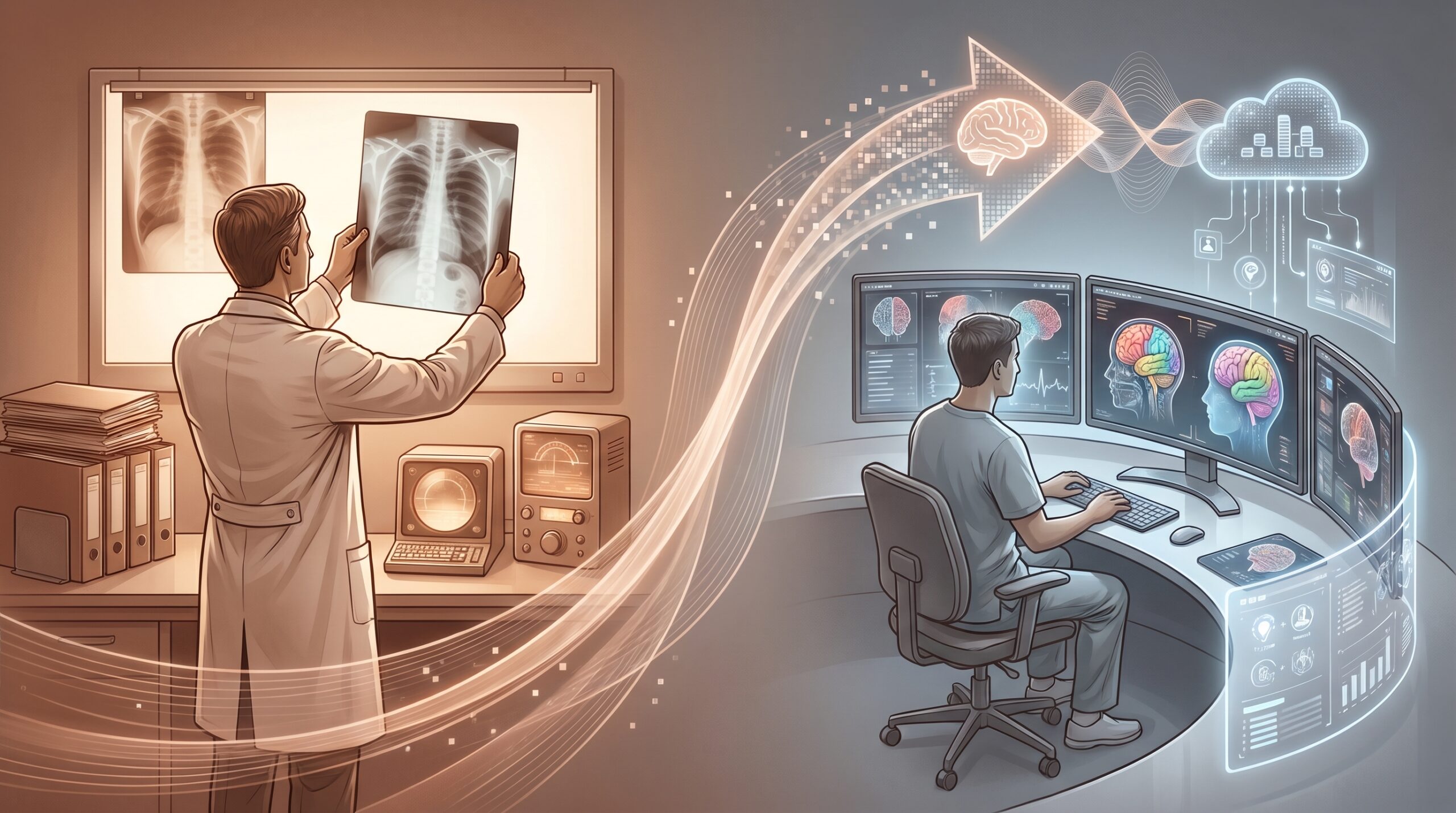
As Stanford’s Curtis Langlotz noted at RSNA 2025, the initial anxieties have largely subsided as radiologists gain direct experience with AI tools. The emerging consensus — articulated consistently at both RSNA 2025 (“Imaging the Individual“) and ECR 2026 (“Rays of Knowledge”) — is that machine intelligence is different from, not superior to, human intelligence. The complementary strengths of AI (tireless consistency, quantitative precision, pattern recognition across massive datasets) and human radiologists (clinical context integration, communication, ethical judgment, handling of edge cases) create a partnership that outperforms either alone.
The Augmentation Paradigm: What AI Does (and Doesn’t Do) for Radiologists
Current AI Applications in Clinical Practice
As of early 2026, the FDA has authorized over 1,450 AI/ML-enabled medical devices cumulatively, with 295 new clearances in 2025 alone. Seventy-five percent of these target radiology — far exceeding any other medical specialty. The dominant applications include computer-aided triage (prioritizing critical findings like intracranial hemorrhage, pneumothorax, and large vessel occlusion), automated quantification (tumor volume, coronary calcium scoring, brain atrophy), and screening support (mammography, lung nodule detection, fracture identification).
However, deployment remains uneven. While over 70% of US radiology departments expressed intent to increase AI reliance by 2025, actual operationalization of AI in daily workflows — where AI output routinely influences clinical decisions — is estimated at approximately 30% of practices. The gap between acquisition and integration reflects challenges in workflow compatibility, PACS integration, training, and the persistent difficulty of demonstrating clear return on investment. AI tools that add friction to existing workflows, regardless of their diagnostic accuracy, tend to be abandoned.
The Agentic AI Frontier
The next frontier is agentic AI — autonomous systems that can execute multi-step tasks without continuous human direction. In radiology, agentic AI could autonomously handle the complete workflow for routine screening examinations: pulling relevant prior imaging, generating measurements, drafting structured reports, and routing only abnormal or uncertain cases for radiologist review. Research presented at RSNA 2025 suggested that human-AI collaboration could potentially eliminate the need for radiologist review of 63% of screening mammograms while improving overall accuracy. This doesn’t eliminate the radiologist; it redirects their expertise toward cases that genuinely require human judgment.
Yet significant barriers remain. Large language models, despite passing board examinations and drafting competent reports, still make potentially harmful errors in differential diagnosis and occasionally generate confident but incorrect statements. The regulatory framework for agentic AI in medicine is still nascent — the EU AI Act, effective for high-risk applications by August 2026, will require rigorous documentation of training data, bias mitigation, and human oversight for any AI classified as high-risk medical software.
| Domain | Traditional Role | AI-Augmented Role (2026+) |
|---|---|---|
| Image interpretation | Sequential review of all studies | AI pre-screens; radiologist focuses on flagged/complex cases |
| Quantification | Manual measurements (tumor, atrophy, calcium) | Automated quantification; radiologist validates |
| Report generation | Dictation from scratch | AI-drafted reports; radiologist edits, contextualizes |
| Workflow prioritization | FIFO or manual triage | AI triages by acuity; critical findings routed first |
| Clinical integration | Image-focused reporting | “Clinical orchestrator” integrating imaging, genomics, clinical data |
| Patient interaction | Minimal direct contact | Expanded role in communicating AI-enhanced findings |
Cumulative FDA-authorized AI/ML medical devices through 2025
Of all FDA-cleared AI devices target radiology
Of diagnostic interpretations contain clinically significant errors — AI aims to reduce this
Salary premium for technicians proficient in AI tools
New Competencies: What Radiologists Need to Learn
The integration of AI demands new competencies that extend beyond traditional image interpretation. Professional societies including RSNA, ESR, and ACR now offer continuing medical education courses on AI fundamentals, and approximately 60% of radiology residency curricula have incorporated AI concepts. The ACR Data Science Institute has developed several programs — including AI-LAB for algorithm development, the Define-AI Directory for use case documentation, AI Central for post-deployment monitoring, and the recently launched ARCH-AI international recognition program for quality AI adoption — that provide structured frameworks for AI governance in radiology departments.
Key competencies for the AI-era radiologist include: understanding the basics of machine learning and foundation model architectures sufficient to critically evaluate AI tool performance claims; familiarity with AI bias, failure modes, and edge cases; the ability to interpret model cards (analogous to “nutrition labels” for AI, describing training data demographics, performance benchmarks, and known limitations); data governance and privacy principles; and perhaps most importantly, the judgment to know when to trust, verify, or override AI output. As Langlotz proposed at RSNA 2025, radiologists should be able to evaluate AI tools the same way they evaluate any new diagnostic technology — with evidence-based scrutiny and clinical common sense.
The “Clinical Orchestrator” Vision
At ECR 2026, Prof. Regina Beets-Tan of the Netherlands Cancer Institute articulated a vision of the radiologist as “clinical orchestrator” — a role that extends far beyond image interpretation. In this model, the radiologist of the future works not from conventional 2D image series but from fully navigable 3D patient reconstructions generated by AI from raw data, integrating imaging findings with genomic profiles, laboratory results, and clinical history into a unified patient assessment. The radiologist coordinates insights across specialties, creating a harmonized patient journey rather than isolated imaging reports.
This vision aligns with the “superdiagnostician” concept — the idea that AI-augmented radiologists, equipped with multimodal AI tools and comprehensive clinical data, can provide diagnostic insight that exceeds what either human or machine could achieve independently. The practical manifestation includes expanded roles in tumor boards, AI-assisted treatment planning, image-guided procedures, and direct patient communication about imaging findings. For radiologists concerned about professional identity in the AI era, the message from both RSNA 2025 and ECR 2026 was consistent: AI will automate tasks, not roles, and the resulting freed capacity should be directed toward higher-value clinical activities.
Anatomy, pathology, image interpretation remain foundational. AI handles routine detection; radiologist handles complex diagnosis.
Understanding ML/DL basics, evaluating model cards, recognizing AI limitations, data governance, post-deployment monitoring.
Combining imaging with radiomics, genomics, clinical data. Tumor boards, treatment planning, precision medicine workflows.
Expanded direct patient interaction. Translating AI-enhanced findings into actionable clinical guidance for referring physicians.
Workforce Implications and Health Equity
The AI-workforce dynamic is shaped by a fundamental supply-demand imbalance. According to the ACR, the US population is growing faster than the number of radiologists entering the workforce — a trend projected to continue for years. AI offers a partial solution by increasing per-radiologist productivity: automating mundane tasks, reducing reporting times (one implementation achieved a 20% reduction), and enabling efficient handling of rising imaging volumes. However, this productivity gain is not distributed equally across practice settings; well-resourced academic centers and large private practices adopt AI earlier, potentially widening quality gaps with rural and underserved communities.
The workforce impact extends to compensation and career dynamics. Radiologists proficient in AI deployment and governance are increasingly valued, while those who resist engagement with AI technology risk professional marginalization. This dynamic represents job displacement — a fundamental change in job description — rather than job replacement. Emerging roles such as “AI champion” (a radiologist who leads AI implementation and monitors performance within a department) and clinical informatics positions reflect this evolution. The field is not shrinking; it is reshaping, and those who engage proactively with the transformation are best positioned to thrive. Equitable access to AI training and tools across practice types and geographies will determine whether the AI era narrows or widens existing workforce disparities.
Future Directions
Looking ahead, several trends will further reshape the radiologist’s role. The regulatory landscape is evolving rapidly: the EU AI Act will impose stringent requirements on high-risk medical AI by 2026, and the FDA is developing life-cycle oversight frameworks that allow adaptive AI to evolve post-clearance under predetermined change control plans. Reimbursement structures must catch up — currently, no dedicated CPT codes exist for AI-aided radiology interpretations, though legislative proposals for dedicated Medicare AI diagnostic device reimbursement are under congressional consideration.
Environmental sustainability is emerging as an unexpected theme. RSNA 2025 highlighted that radiology departments can account for up to 24% of a hospital’s carbon emissions, and AI-driven workflow optimization — reducing unnecessary repeat scans, optimizing scanner utilization, and enabling energy-efficient protocols — offers both environmental and economic benefits. The acceleration of MRI through deep learning reconstruction exemplifies how AI can simultaneously improve image quality, reduce scan time, lower energy consumption, and enhance the patient experience.
The radiologist who will thrive in 2030 and beyond will be defined not by their ability to detect a subtle finding faster than an algorithm, but by their capacity to integrate AI output with clinical context, communicate complex findings to patients and colleagues, govern AI deployment within ethical and regulatory frameworks, and champion equitable access to AI-enhanced care. The specialty that pioneered digital medicine is well positioned to lead the next transformation — provided it embraces the change deliberately rather than defensively.
Clinical Implications
The message from the global radiology community in 2025–2026 is remarkably unified: AI is a force multiplier for radiologists, not an existential threat. However, this optimism is conditional. It requires active engagement — learning AI fundamentals, participating in implementation decisions, advocating for equitable deployment, and maintaining the clinical expertise that gives AI output its meaning. Departments that invest in AI governance structures, designate AI champions, and integrate AI literacy into training will be better positioned than those that either ignore the technology or adopt it without adequate oversight. The profession’s future lies not in competing with AI at tasks machines do well, but in excelling at the distinctly human contributions that machines cannot replicate: clinical judgment, communication, empathy, and the integration of complex, uncertain, and context-dependent information into actionable care decisions.
References
- Langlotz CP. The future of AI and informatics in radiology: 10 predictions. Radiology. 2023;309(2):e231114.
- RSNA. The future of radiology: AI’s transformative role in medical imaging. RSNA 2025 Session Summary. January 2025.
- ECR 2026. Rays of Knowledge: attendance at record high. ESR Press Release. March 11, 2026.
- Beets-Tan R, Gouveia P. Enhanced by AI, but guided by humans: radiology’s vision for 2050. ECR 2026 Plenary Session. March 2026.
- FDA. Artificial intelligence and machine learning (AI/ML)-enabled medical devices. Device Tracker. Updated January 2026. Cumulative authorizations: 1,451 through end-2025.
- IntuitionLabs. FDA’s AI medical device list: stats, trends, and regulation. Updated March 2026.
- Al-Tahan M, et al. The role of AI in mitigating the impact of radiologist shortages: a systematised review. Health Technol. 2025;15(3):489-501.
- RadAI. 5 RSNA trends set to redefine radiology in 2026. December 2025.
- Definitive Healthcare. RSNA 2025 recap: AI and the future of radiology. December 2025.
- ACR. ACR leaders chart the future of radiology AI at ECR 2026. March 2026.
- IntuitionLabs. AI in radiology: 2025 trends, FDA approvals, and adoption. November 2025.
- Pesapane F, Codari M, Sardanelli F. Artificial intelligence in medical imaging: threat or opportunity? Radiologists again at the forefront of innovation in medicine. Eur Radiol Exp. 2018;2:35.
- RadAI. RSNA 2025: five trends shaping radiology’s next chapter. November 2025.
- Topol EJ. High-performance medicine: the convergence of human and artificial intelligence. Nat Med. 2019;25(1):44-56.
- European Parliament. Artificial Intelligence Act. Regulation (EU) 2024/1689. Official Journal. August 2024.
- Brady AP, Neri E. Artificial intelligence in radiology — ethical considerations. Diagnostics. 2020;10(4):231.
Disclaimer: This article reflects the views expressed at major radiology conferences and in published literature as of April 2026. The evolving nature of AI regulation and deployment means specific details may change rapidly. MedTrainHub has no financial relationship with any AI vendor or professional society mentioned.
Conflicts of Interest: None declared.
Suggested Citation: MedTrainHub Editorial Team. The Evolving Role of Radiologists in the AI Era. MedTrainHub.com. April 2026.